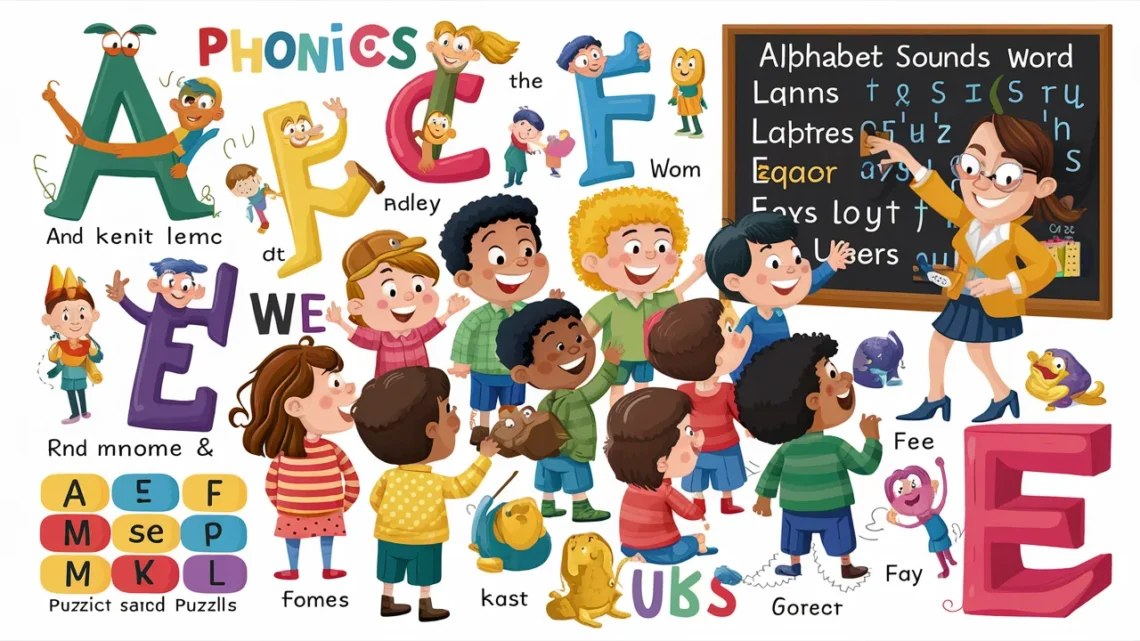
The Jolly Phonics Jolly Phonics approach has transformed early literacy education by introducing a fun, engaging, and highly effective method of teaching reading and writing. Developed by Sue Lloyd and Sara Wernham, the Jolly Phonics program is based on the principles of synthetic phonics, where children learn to read by blending sounds rather than memorizing whole words.
We explore the complete framework of Jolly Phonics, providing a detailed, authoritative, and practical guide that supports educators and parents in achieving strong literacy outcomes.
What Is Jolly Phonics and How It Works
Jolly Phonics is a structured literacy program designed to teach children the core skills needed for reading and writing. The method focuses on five key skills:
- Learning letter sounds
- Letter formation
- Blending sounds
- Identifying sounds in words
- Recognizing tricky words
Unlike traditional methods, Jolly Phonics emphasizes active learning through multi-sensory techniques, ensuring children remain engaged throughout the process. By combining visual, auditory, and kinesthetic learning, the program enhances retention and understanding.
The 42 Letter Sounds System
One of the most distinctive features of Jolly Phonics is its systematic introduction of 42 letter sounds. These sounds are taught in groups rather than alphabetical order, allowing children to start forming words quickly.
The sequence is carefully designed to maximize early success. Children begin with simple sounds and gradually progress to more complex phonetic patterns. This structured approach ensures that learners build confidence as they develop their reading skills.
Each sound is associated with a specific action, helping children remember it more effectively. This multi-sensory approach strengthens memory and reinforces learning.
Multi-Sensory Learning Approach
The success of Jolly Phonics lies in its multi-sensory teaching method, which engages children through:
- Actions and gestures
- Songs and rhymes
- Visual aids and storytelling
This approach ensures that learning is not only effective but also enjoyable. By involving movement and sound, children can connect with the material in a deeper way, improving comprehension and retention.
The use of actions for each sound allows learners to associate physical movement with phonetic concepts, making it easier to recall sounds when reading or writing.
Blending and Segmenting Skills
Blending and segmenting are essential components of the Jolly Phonics method. Blending involves combining individual sounds to form words, while segmenting requires breaking words into their component sounds.
These skills are crucial for developing reading fluency and spelling accuracy. Through consistent practice, children learn to decode unfamiliar words and build confidence in their reading abilities.
The program provides numerous exercises and activities to reinforce these skills, ensuring learners develop a strong foundation in literacy.
Teaching Tricky Words Effectively
Not all words follow standard phonetic rules. Jolly Phonics addresses this challenge by introducing tricky words, which must be learned by sight.
The program uses repetition and visual recognition techniques to help children memorize these words. By integrating tricky words into lessons, learners can improve reading fluency without becoming discouraged by irregular spelling patterns.
Benefits of Jolly Phonics for Early Learners
Jolly Phonics offers a wide range of benefits, making it one of the most popular literacy programs worldwide:
- Improved reading and writing skills
- Enhanced phonemic awareness
- Increased confidence in learners
- Engaging and interactive learning experience
The structured approach ensures that children progress steadily, building a solid foundation for future academic success.
Using Jolly Phonics at Home and in the Classroom
Jolly Phonics is highly versatile and can be effectively implemented both at home and in educational settings. Parents can support their children by practicing sounds, reading together, and reinforcing lessons through everyday activities.
In classrooms, teachers can use a variety of resources, including workbooks, flashcards, and interactive activities, to create a dynamic and engaging learning environment.
Consistency is key to success. Regular practice ensures that children retain what they learn and continue to build their skills over time.
Jolly Phonics vs Traditional Phonics Methods
Compared to traditional phonics approaches, Jolly Phonics offers a more interactive and engaging learning experience. While conventional methods often rely on repetition and memorization, Jolly Phonics incorporates movement, music, and storytelling.
This difference makes the program particularly effective for young learners, as it keeps them motivated and interested. The emphasis on synthetic phonics also ensures that children develop strong decoding skills, enabling them to read independently.
Long-Term Impact on Literacy Development
The impact of Jolly Phonics extends beyond early learning. By establishing a strong foundation in phonics, the program prepares children for advanced reading and writing tasks.
Students who learn through Jolly Phonics often demonstrate:
- Strong decoding skills
- Improved spelling accuracy
- Greater confidence in reading
These benefits contribute to long-term academic success, making the program a valuable investment in a child’s education.
Conclusion: Why Jolly Phonics Jolly Phonics Stands Out
The Jolly Phonics Jolly Phonics method remains one of the most effective and widely used approaches to teaching early literacy. Its combination of structured learning, multi-sensory engagement, and practical application ensures that children develop essential reading and writing skills in an enjoyable and meaningful way.
By focusing on sound recognition, blending, and interactive learning, Jolly Phonics provides a comprehensive and proven pathway to literacy success. For parents and educators seeking a reliable and engaging phonics program, it continues to stand as a leading choice.
Frequently Asked Questions (FAQ)
What age is Jolly Phonics suitable for?
Jolly Phonics is typically designed for children aged 4 to 7, but it can be adapted for older learners as well.
How long does it take to complete Jolly Phonics?
The program can be completed within one academic year, depending on the pace of learning.
Is Jolly Phonics effective for all learners?
Yes, its multi-sensory approach makes it suitable for a wide range of learning styles.
Can parents teach Jolly Phonics at home?
Absolutely. With the right resources and consistency, parents can effectively use the program at home.
What makes Jolly Phonics different from other phonics programs?
Its use of actions, songs, and multi-sensory techniques sets it apart, making learning more engaging and effective.