There is something undeniably magnetic about national flags. They are not just pieces of colored fabric that flutter in the wind outside government buildings. They are the heartbeat of a nation, the visual shorthand for a people’s history, their struggles, and their ultimate hopes for the future. When you look at the flag of Cuba, you are looking at one of the most striking and historically significant designs in the Americas. It is bold, it is geometric, and it carries a weight of history that goes back well over a century. Whether you are walking down the streets of Havana, visiting Little Havana in Miami, or just curious about vexillology (the study of flags), understanding the Cuban flag requires us to peel back the layers of time. It is a story of exile, revolution, secret societies, and a longing for freedom that has transcended generations. In this article, I want to take you on a journey through the story of “La Estrella Solitaria,” or the Lone Star, and explore what makes this banner so special to millions of people around the world.
To truly understand the Cuban flag, we have to travel back in time, not to the tropical heat of Havana, but surprisingly, to the bustling streets of New York City in 1849. It is a fascinating fact that the ultimate symbol of Cuban identity was actually born in the United States. The flag was the brainchild of Narciso López, a Venezuelan-born general who became a champion for Cuban independence from Spanish colonial rule. López was living in exile in New York, plotting his return to the island to liberate it. He wanted a symbol that his future army could rally behind, something that would distinguish them from the Spanish forces. Legend has it that López woke up from a nap one day and looked out the window at the morning sky. He saw distinct colors in the clouds at dawn—triangles of red, stripes of white and blue, and the morning star.
While the “dream” story is romantic, the actual design process involved collaboration. López worked with a poet and patriot named Miguel Teurbe Tolón. They sat down to sketch out the ideas, aiming to encode their revolutionary ideals into the very geometry of the flag. Once the design was finalized, it wasn’t manufactured in a factory. It was hand-sewn by Miguel’s wife, Emilia Teurbe Tolón. She crafted the very first version of what we now recognize as the Cuban flag. This adds such a personal, human element to the history. It wasn’t designed by a committee or a government agency but by a group of passionate exiles in a foreign land, dreaming of a home that was free. The flag was first flown on Cuban soil on May 19, 1850, when López led an expedition to the city of Cárdenas. Although that specific uprising failed, the flag remained. It had captured the imagination of the people, and by the time Cuba officially gained independence in 1902, there was no other choice for the national banner.
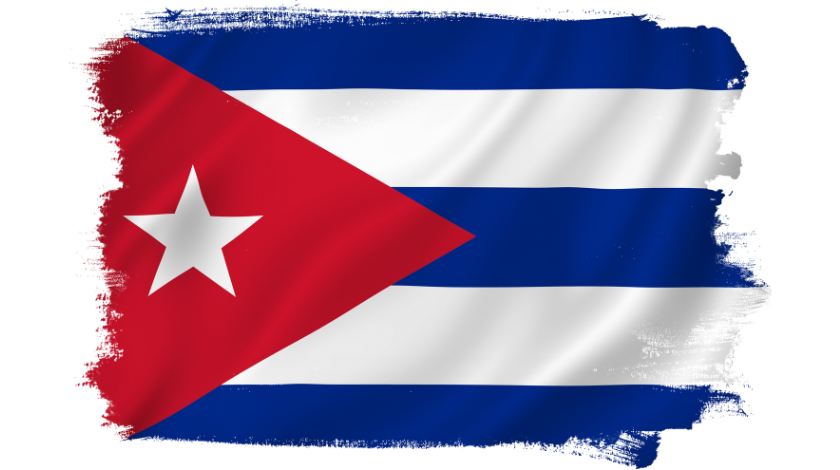
Now, let us move away from the history books for a moment and look at the flag itself. What do those shapes and colors actually mean? It is easy to look at a flag and just see pretty colors, but almost every element of the Cuban flag was chosen with a very specific purpose in mind. The design consists of five horizontal stripes, a red equilateral triangle on the hoist side, and a white five-pointed star centered within that triangle.
First, let’s talk about the stripes. You will notice there are three blue stripes. These are not just random lines. In the mid-19th century, the island of Cuba was administratively divided into three military departments: the Occidental (West), the Central, and the Oriental (East). Those three blue bands represent these three regions of the country. It was a way of saying that the entire island, from one end to the other, was united in this cause. Then you have the two white stripes that separate the blue ones. The color white in heraldry and flag design almost always symbolizes purity. In this specific context, the white stripes represent the purity of the ideals of the independence movement. It suggests that their cause for freedom was just, noble, and untainted by corruption or malice.
The most dominant feature, visually speaking, is the red equilateral triangle. To understand this, you have to know a little bit about the Freemasons. Narciso López and many of the early Cuban patriots were Freemasons, and Masonic imagery played a huge role in the design. The triangle is a classic Masonic symbol of equality and strength. However, the color red has a more visceral meaning. As is the case with many national flags, the red symbolizes the blood shed by the patriots in the struggle for independence. It is a somber reminder that freedom is rarely free; it is paid for with the lives of those who fight for it. Additionally, the three sides of the triangle represent the triad of Liberty, Equality, and Fraternity, echoing the ideals of the French Revolution which inspired so many movements in the Americas.
Finally, we have the star. The white star, or “La Estrella Solitaria,” sits right in the center of the red triangle. This is perhaps the most important part of the flag’s identity. The star represents the independent and sovereign republic. It was meant to shine alone, suggesting that Cuba should stand on its own as a free nation. There is a lot of poetic beauty in that idea. Even when the flag is surrounded by darkness or turmoil, that single white star remains bright, symbolizing hope and the enduring spirit of the Cuban people. When I look at the flag, the star is what draws my eye first. It feels optimistic, a singular point of light leading the way forward.
One of the most common things people ask me when we talk about flags is, “Wait, isn’t that the Puerto Rican flag?” This is a very valid question because, to the untrained eye, the two flags look almost exactly the same. They share the same geometric design: the five stripes, the triangle, and the star. The only difference is the color placement. On the Cuban flag, the stripes are blue and the triangle is red. On the Puerto Rican flag, the stripes are red and the triangle is blue.
This similarity is not a coincidence or a case of plagiarism. It is a symbol of brotherhood. In the late 19th century, the independence movements of Cuba and Puerto Rico were closely linked. The Puerto Rican section of the Cuban Revolutionary Party was founded in New York in the 1890s. They adopted a flag that was essentially the inverse of the Cuban flag to show solidarity. The idea was that they were “two wings of the same bird,” fighting against the same Spanish colonial power. So, when you see these flags together, do not think of it as a mistake. Think of it as a historical pact between two Caribbean neighbors who shared a common dream of liberty. I find it incredibly touching that their histories are woven together so tightly that their national symbols are essentially mirror images of one another.
When we discuss the cultural impact of this flag, we have to look beyond the government and look at the people. Having spent time talking to Cubans both on the island and in the diaspora, I have realized that the flag is a unifying object in a community that is often politically divided. You will see the Cuban flag hanging in the living rooms of families in Miami who left the island sixty years ago, and you will see it painted on the walls of the Malecón in Havana. It appears in the artwork of exiles and in the official propaganda of the state.
For many, the flag evokes a deep sense of nostalgia (or nostalgia, as it is felt in Spanish). It represents the land itself—the palm trees, the ocean, the mountains of the Sierra Maestra, and the streets of Old Havana. I remember seeing a piece of art once that depicted the flag not as cloth, but as a landscape, with the blue stripes turning into ocean waves. That is how many people feel about it. It is not just a political symbol; it is a representation of home. Whether you agree with the current politics of Cuba or not, the flag remains a sacred object of heritage for anyone with Cuban blood. It transcends the political shifts of the last century and connects people back to those original ideals of 1849.
If you ever plan to own or display a Cuban flag, it is good to know that there are traditions and protocols associated with it, just like there are for the American or British flags. In Cuba, the flag is treated with immense reverence. It should never touch the ground, and it should never be used as a costume or part of a piece of clothing in a disrespectful way (though you will often see it on t-shirts in tourist shops, official protocol frowns on using the actual flag as fabric for clothes).
When the flag is hung horizontally, the star should be on the left. If it is hung vertically, the triangle with the star should still be at the top, but the star should be oriented properly so it doesn’t look upside down. There is also a specific way to fold it into a triangle, much like the American flag, to protect the star. Showing respect to the flag is a way of showing respect to the history and the people it represents. I always advise people that if they are going to fly a foreign flag, they should take a moment to learn these little rules. It shows that you appreciate the culture and are not just using the symbol as a decoration.
To wrap things up, the Cuban flag is a masterpiece of vexillology that tells a dramatic story of the fight for freedom. From its inception in a New York boarding house to its status today as a global icon, it has served as a beacon for millions. The three blue stripes remind us of the history of the land, the white stripes remind us of the purity of intention, the red triangle reminds us of the blood spilled for liberty, and that lone white star represents the ultimate goal of sovereignty. It is a flag that demands attention, not just because of its bright, contrasting colors, but because of the intense emotion and history packed into every square inch of it. Whether you are Cuban, have Cuban friends, or just appreciate history, looking at this flag is looking at the soul of a nation that has never stopped fighting for its identity.
Conclusion
In summary, the Cuban flag is far more than a colorful souvenir from a Caribbean vacation. It is a historical document woven in thread. It was born out of the yearning for independence and has survived revolutions, changes in government, and the test of time. Understanding the distinction between the Cuban and Puerto Rican flags, recognizing the deep symbolism of the “Estrella Solitaria,” and knowing the history of Narciso López adds a rich layer of context to this beautiful banner. Next time you see those blue and white stripes waving, you will know the story of sacrifice and hope that they carry.
Frequently Asked Questions (FAQ)
1. Why are the Cuban and Puerto Rican flags so similar?
They are similar because the Puerto Rican independence movement designed their flag in the 1890s to mirror the Cuban flag. This was done to show solidarity and brotherhood between the two islands as they both fought for independence from Spain. The colors are simply inverted; Cuba has blue stripes and a red triangle, while Puerto Rico has red stripes and a blue triangle.
2. What does the single white star represent?
The white star, known as “La Estrella Solitaria” (The Lone Star), represents independence and sovereignty. It symbolizes the idea that Cuba should stand on its own as a free republic, shining bright and distinct among other nations.
3. Who designed the Cuban flag?
The concept came from General Narciso López in 1849. The actual design was refined by the poet Miguel Teurbe Tolón, and the very first flag was sewn by his wife, Emilia Teurbe Tolón, while they were living in exile in New York City.
4. What do the three blue stripes stand for?
The three blue stripes represent the three administrative and military departments that Cuba was divided into at the time the flag was designed in the mid-19th century: The West (Occidental), the Center (Central), and the East (Oriental).
5. Is it illegal to wear the Cuban flag?
While you will see many tourists wearing t-shirts with the flag print, official Cuban protocol states that the flag itself should be treated with great respect and not used as a costume, drapery, or sportswear. However, wearing clothing depicting the flag is generally common and accepted, provided it is done respectfully.