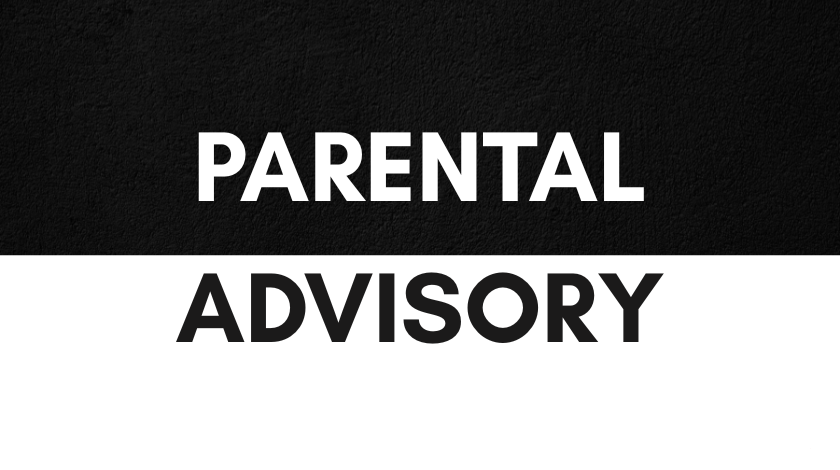
If you grew up in the 1990s or early 2000s like I did, you probably remember the rush of walking into a music store. You would flip through the plastic cases of CDs, looking for your favorite artist. And there it was. That little black and white rectangle in the bottom corner of the album cover. It read “Parental Advisory Explicit Content.” For a worried parent, that sticker was a red flag warning them to keep their wallet closed. But for us kids? Let’s be honest. That sticker was a magnet. It was a promise that the music inside was cool, edgy, and something we probably were not supposed to hear.
That simple logo is one of the most recognizable symbols in pop culture history. It has been printed on millions of albums, t-shirts, and posters. But many people today do not realize the intense political battle and the wild history that birthed that little sticker. It was not just a design choice. It was the result of a massive clash between Washington politicians, concerned mothers, and rock stars. In this article, I want to take a deep dive into what the Parental Advisory label actually means, where it came from, and how it still affects the music we stream on Spotify and Apple Music today.
The Spark: How Prince Started a Revolution
To understand the label, we have to travel back to 1984. It was a different time. There was no internet, and if you wanted to hear music, you had to buy the record or listen to the radio. The story goes that Tipper Gore, who was the wife of future Vice President Al Gore, bought the soundtrack to the movie Purple Rain for her 11-year-old daughter. She thought it was safe. But then she heard the song “Darling Nikki” by Prince. The song contains some very specific and mature references to sexual acts. Tipper Gore was shocked. She felt like she had been tricked into bringing adult content into her home.
This personal experience sparked a fire. Tipper Gore gathered other influential women in Washington, D.C., many of whom were married to powerful politicians. Together, they formed a group called the Parents Music Resource Center, or the PMRC. Their goal was simple on the surface. They wanted to inform parents about what was in the music their kids were buying. However, the way they went about it felt a lot like censorship to the artists. They released a list known as the “Filthy Fifteen.” This was a list of fifteen songs that they believed were the absolute worst examples of violence, drug use, and sexual content in music. The list included heavy metal bands like Judas Priest and pop stars like Madonna and Prince.
The 1985 Senate Hearings: Rockers in Suits
Things got very serious very quickly. In 1985, the United States Senate held hearings on the matter. It was a surreal moment in American history. You had stuffy politicians sitting across from long-haired musicians, arguing about the definition of art. The PMRC wanted a rating system, similar to how movies are rated G, PG, or R. The musicians, however, saw this as a violation of their First Amendment rights to free speech.
Three musicians famously testified against the PMRC: Frank Zappa, Dee Snider of Twisted Sister, and John Denver. Everyone expected Frank Zappa to be rebellious, and he was. But Dee Snider surprised everyone. He walked in wearing his denim vest and tight jeans, looking like a total rock star. The politicians expected him to be unintelligent. Instead, he gave a calm, articulate, and brilliant speech. He pulled a folded piece of paper out of his pocket and dismantled their arguments one by one. Then came John Denver. The PMRC thought Denver, a wholesome country singer, would be on their side. But he compared their proposals to Nazi book burnings. He argued that once you start censoring art, you are on a slippery slope that is dangerous for democracy.
Despite the strong defense from the artists, the pressure was too high. The record industry, represented by the Recording Industry Association of America (RIAA), knew they had to do something to get the government off their backs. They agreed to voluntarily place a warning label on albums with explicit lyrics. After a few design changes over the years, this eventually became the standard black and white “Parental Advisory Explicit Content” logo we know today.
How the Label Actually Works
One huge misconception I often hear is that the government forces artists to put this sticker on their albums. That is actually not true. The Parental Advisory label is a voluntary program administered by the RIAA. It is not a government law. When an artist or a record label finishes an album, they review the lyrics. If they think the content is too mature, they decide to slap the sticker on the cover.
So, what qualifies as explicit? It is not an exact science, which can be frustrating for some people. Generally, the RIAA suggests using the label if the music contains strong language, depictions of violence, sex, or substance abuse. But context matters. A song about history that mentions violence might not get a sticker, while a heavy metal song glorifying violence will. Because it is voluntary, some artists use it liberally, while others might try to avoid it to get their albums sold in big retail stores like Walmart.
This brings up another interesting point about the “Clean” version. Big retailers like Walmart often refused to stock albums with the Parental Advisory label. They wanted to maintain a family-friendly image. So, record labels started making two versions of an album. You would have the “Explicit” version with the sticker and the bad words left in. Then, you would have the “Clean” or “Edited” version. In the clean version, the curse words might be silenced, reversed, or replaced with different words. I remember buying a DMX album as a kid that was the edited version, and half the album was just silence because they had to cut so much out. It ruined the listening experience, but it was the only way to buy the CD at a mainstream store.
The “Forbidden Fruit” Effect
We have to ask the question: Did the sticker actually work? If the goal was to stop kids from listening to dirty lyrics, I would argue it failed miserably. In fact, it often had the opposite effect. In psychology, we call this the “forbidden fruit” effect. When you tell a teenager they cannot have something, they want it even more.
For genres like Hip-Hop and Heavy Metal, the Parental Advisory sticker became a badge of honor. It was a marketing tool. If an album had that sticker, you knew it was raw and uncensored. N.W.A., Eminem, and 2 Live Crew didn’t hide from the controversy; they used it to sell millions of records. I remember being in middle school, and having a CD with that sticker on it felt like a rite of passage. It made you feel rebellious. So, while the PMRC wanted to protect children, they inadvertently helped market explicit music to an entire generation of teenagers.
There is also the financial side of things. Some people argue that the label hurt sales because some stores wouldn’t carry the albums. But for the biggest artists, it didn’t matter. They sold millions of copies regardless. The controversy provided free publicity. The more the news talked about how “dangerous” a rap album was, the more kids went out to buy it to see what the fuss was about.
From Stickers to Streaming: The “E” Symbol
Fast forward to today. Most people do not buy physical CDs anymore. We stream music on Spotify, Apple Music, or YouTube. So, is the Parental Advisory label still relevant? The answer is yes, but it looks a little different.
On streaming platforms, you will usually see a small, grey “E” box next to a song title or an album. That “E” stands for Explicit. It serves the exact same purpose as the old sticker. It tells you that the track contains mature content. Just like in the old days, streaming services often offer the clean version of the album alongside the explicit one. If you look up a popular album on Spotify, you might see it listed twice. One will have the little “E” icons, and the other will not.
The responsibility for filtering this content has shifted from the cashier at the record store to the software settings on your phone. In the 90s, a cashier could look at a kid and refuse to sell them a CD with a sticker. Today, a 10-year-old with an iPhone has access to every song ever recorded. This makes the digital tag very important for parents who want to filter what their children hear.
A Guide for Parents in the Digital Age
As we discuss this, I want to speak directly to the parents reading this. Managing what your children listen to is much harder now than it was thirty years ago. You cannot just hide a CD case in a drawer. However, modern technology gives you tools that Tipper Gore could only have dreamed of.
If you use Spotify, you can actually go into the settings and toggle a switch that says “Allow Explicit Content.” If you turn this off, the app will grey out any song with the “E” tag. It simply won’t play. Apple Music has similar restrictions under the “Screen Time” settings on an iPhone. You can set the phone to only play “Clean” music. This is a very effective way to filter out the heavy cursing if that is your main concern.
However, I believe that technology is only one part of the solution. The sticker or the “E” tag only tells you so much. It doesn’t tell you the context. Is the song using a bad word to tell a powerful story about overcoming struggle? Or is it just being vulgar for the sake of being vulgar? A sticker treats both of those things the same way.
From my perspective, the best approach is communication. The PMRC hearings in the 80s were all about adults talking about kids, not to kids. If you see your child listening to an artist with a Parental Advisory warning, ask them about it. Listen to the song together. Ask them what they think the lyrics mean. You might be surprised. Sometimes kids just like the beat and aren’t even paying attention to the words. Other times, they might understand the themes better than you give them credit for.
Conclusion
The Parental Advisory label has come a long way since the days of the “Filthy Fifteen.” It started as a heated political battle that threatened to censor artists. It turned into a cultural symbol that defined the rebellious spirit of the 90s and 2000s. And now, it has evolved into a digital metadata tag on our smartphones.
While the methods of listening to music have changed, the core debate remains the same. It is the balance between an artist’s right to express themselves freely and a parent’s right to decide what is appropriate for their family. The black and white sticker is a tool, not a solution. It gives you a heads-up, a warning sign. But it is up to us, as listeners and parents, to decide what we do with that information. Whether you view the label as a helpful guide or a relic of censorship, there is no denying that it changed the music industry forever.
Frequently Asked Questions (FAQ)
Q: Is the Parental Advisory label required by law?
A: No, it is not a law. The label is a voluntary program created by the Recording Industry Association of America (RIAA). Record labels and artists decide for themselves if their music requires the label based on the content.
Q: Does the “E” on Spotify mean the same thing as the sticker?
A: Yes. The “E” symbol next to a song on Spotify or Apple Music stands for “Explicit.” It indicates that the track contains strong language, violence, or sexual themes, just like the physical sticker did.
Q: Can I sell my music without the label if it has curse words?
A: Technically, yes, because it is voluntary. However, many digital distributors and streaming platforms require you to mark your tracks as “Explicit” if they contain profanity. If you don’t, they might remove your music or hide it because it violates their terms of service regarding correct metadata.
Q: Who decides if a song gets the label?
A: usually, the record label and the artist decide. There is no independent board that listens to every song released. It is a self-regulation system.
Q: Did the Parental Advisory label ban any music?
A: The label itself does not ban music. However, in the past, certain retailers (like Walmart) refused to stock albums that carried the label, which effectively acted as a ban in those specific stores. Today, with streaming, the music is widely available regardless of the label.