When most people hear the words “Great White Shark,” the first image that pops into their minds is usually from a movie. We all know the one. It involves a massive mechanical beast terrorizing a beach town, scary music building up to a crescendo, and a general sense of panic. While that makes for thrilling Hollywood entertainment, the reality of the animal known scientifically as Carcharodon carcharias is far more complex and fascinating. I have spent years reading about marine biology and watching these majestic creatures in documentaries, and the more you learn, the more you realize that fear should actually be replaced by respect. The Great White isn’t a mindless eating machine. It is a sophisticated, ancient traveler that plays a critical role in keeping our blue planet healthy. In this guide, we are going to dive deep into the world of the Great White Shark, exploring everything from their biology to the truth about shark attacks, all while keeping things simple and easy to understand.
Understanding the Physical Power of the Great White
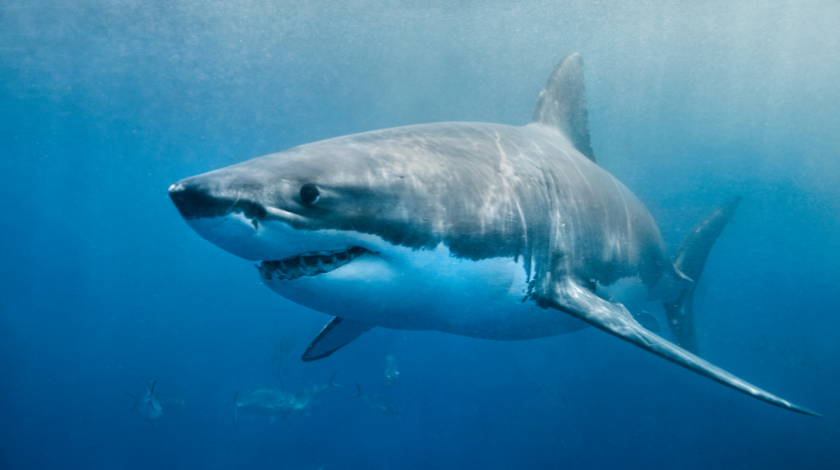
Let us start with the physical attributes because, quite honestly, they are impressive. The Great White Shark is the largest predatory fish on Earth. Notice I said “predatory fish” because the Whale Shark is bigger, but it only eats tiny plankton. A fully grown Great White can grow up to 20 feet in length, though most are between 12 and 16 feet. To put that in perspective, that is roughly the size of a large minibus or a camper van swimming next to you. They can weigh anywhere from 1,500 to 4,000 pounds. Despite this massive bulk, they are shaped like torpedoes. This shape allows them to slice through the water with incredible efficiency. When you look at their skin, it is not smooth like a dolphin. It is made of tiny teeth-like scales called dermal denticles. These scales reduce friction, allowing the shark to move silently and quickly.
Of course, we have to talk about the teeth. This is what everyone wants to know about. A Great White does not just have one row of teeth. They have rows upon rows of serrated, triangular teeth that act like steak knives. Behind the main row, there are backup rows ready to rotate forward if a tooth is lost. Over a lifetime, a single shark might go through thousands of teeth. But there is another physical trait that is even cooler than their teeth. Most fish are cold-blooded, meaning their body temperature matches the water. Great Whites are different. They have a special system that allows them to keep their stomach and brains warmer than the surrounding water. This is a game-changer. It means they can hunt in colder waters where other sharks would be too slow to move. It gives them the energy for bursts of speed that can reach up to 35 miles per hour.
Global Habitats: Where Can You Find Them?
There is a common misconception that Great Whites just hang around beaches waiting for swimmers. This is simply not true. These sharks are global citizens. They are found in cool, coastal waters all over the world. You will find large populations in the United States (specifically California and the Northeast), South Africa, Japan, Chile, and the Mediterranean. They love areas where the water temperature is between 54 and 75 degrees Fahrenheit. However, they are not just coastal homebodies. Scientists have tagged these sharks and watched in amazement as they crossed entire oceans.
One of the most interesting discoveries in recent years is something researchers call the “White Shark Café.” This is an area in the middle of the Pacific Ocean, halfway between Baja California and Hawaii. For years, scientists did not know where the sharks went during the winter. It turns out they travel thousands of miles to this specific spot in the open ocean. Why do they go there? That is still a bit of a mystery. Some experts think it is for mating, while others think there might be a deep-water food source we don’t know much about yet. It just goes to show that even with all our modern technology, nature still holds secrets. These migration patterns prove that the Great White is an ocean wanderer, capable of navigating the vast deep blue with precision.
Diet and Hunting Techniques
So, what fuels a 4,000-pound animal? If you believe the movies, they eat people, license plates, and tires. In reality, their diet is very specific and changes as they age. When Great Whites are pups (babies), they mostly eat fish and rays. As they grow and their teeth get wider and stronger, they switch to their favorite food source: marine mammals. We are talking about seals, sea lions, and elephant seals. These animals have a lot of blubber (fat), which gives the shark the high amount of energy it needs to power its massive body. They also eat large fish like tuna and even other sharks.
Their hunting style is distinct and terrifyingly effective. They are ambush predators. A Great White will usually patrol deep below the surface, looking up. The dark grey color on their back blends in with the dark ocean floor, while their white belly blends in with the sunlight from above. This camouflage is called countershading. When they spot a seal on the surface, they swim upward with an explosive burst of speed. In places like South Africa, you can see them “breach,” which means they jump completely out of the water with a seal in their jaws. It is a display of raw power. However, they do not just eat anything. They are actually quite picky. If a shark bites something and it doesn’t have enough fat content, they will often spit it out. This brings us to a very important topic regarding humans.
Great White Sharks and Humans
This is the part of the article where we need to have a serious conversation about safety and reality. Yes, Great White Sharks are dangerous. They are wild animals with sharp teeth, and they should be respected. However, humans are not their natural prey. We are too bony. We do not have the thick layer of blubber that a seal has. A shark needs high-calorie food to survive, and a human just does not provide that.
So, why do attacks happen? Most experts agree that the majority of Great White incidents are cases of mistaken identity or curiosity. Imagine you are a shark looking up at the surface. You see a surfer paddling on a board. The silhouette looks almost exactly like a seal. The shark takes a bite to investigate. This is often called an “exploratory bite.” The shark realizes, “Ew, this is bone and wetsuit, not tasty fat,” and usually swims away. Sadly, because the shark is so big, even one exploratory bite can be fatal for a human due to blood loss. But it is rarely an act of malice. They aren’t hunting us. If they were hunting us, considering how many people swim in the ocean every day, there would be thousands of attacks. Instead, there are very few. You are statistically more likely to be injured by a toaster or a cow than a Great White Shark.
Conservation Status: Why We Must Protect Them
It might seem strange to say we need to protect a creature that can scare us so much, but we absolutely do. The Great White Shark is listed as “Vulnerable” by conservation groups. Their numbers have dropped significantly over the last fifty years. There are a few reasons for this. First, they grow very slowly and do not reproduce until they are older. This means they cannot bounce back quickly if their population takes a hit. Second, they often get caught in commercial fishing nets meant for other fish (this is called bycatch). And third, there is still a black market for their jaws and fins.
Why does it matter if they disappear? Great Whites are apex predators. This means they are at the very top of the food chain. They play a police role in the ocean. They eat sick and weak animals, which prevents the spread of disease. They also keep the populations of other animals, like seals, in check. If you remove the Great White, the seal population might explode, which would then wipe out the fish population, and the whole ecosystem could collapse. A healthy ocean needs sharks. When we see a Great White, we should see it as a sign of a healthy ocean environment.
Conclusion
The Great White Shark is one of the most magnificent animals on our planet. It is a survivor from a prehistoric time, perfectly adapted to its environment. While it is natural to feel a little fear when we think about their teeth and power, we have to look past the monster myth created by Hollywood. These are intelligent, complex creatures that travel the world and keep our oceans balanced. They are not out to get us. In fact, they usually try to avoid us. As we learn more about them, from their mysterious meetings at the White Shark Café to their picky eating habits, we can start to appreciate them for what they truly are: the guardians of the blue frontier. Protecting them ensures that our oceans remain wild, healthy, and full of life for generations to come.
FAQs
Q1: How big is the largest Great White Shark ever recorded?
A: The largest Great White ever reliably recorded is a female named “Deep Blue.” She was spotted off the coast of Mexico and is estimated to be around 20 feet (6 meters) long and over 50 years old.
Q2: Do Great White Sharks sleep?
A: Sharks do not sleep like humans do. They have periods of rest, but Great Whites must keep swimming to push water over their gills so they can breathe. If they stop moving completely, they would suffocate.
Q3: Can a Great White Shark survive in an aquarium?
A: No. Attempts to keep Great Whites in captivity have failed. They need vast open oceans to swim long distances, and they often injure themselves by swimming into the glass walls of tanks. They become very stressed and refuse to eat in captivity.
Q4: What should I do if I see a shark while swimming?
A: If you see a shark, stay calm. Do not splash or make sudden movements, as this mimics a distressed fish. Maintain eye contact with the shark if possible and slowly back away toward the shore or a boat.
Q5: How many teeth does a Great White Shark lose in its lifetime?
A: A single Great White can go through over 20,000 teeth in its lifetime. They are constantly shedding old teeth and replacing them with new, sharp ones from the rows behind.